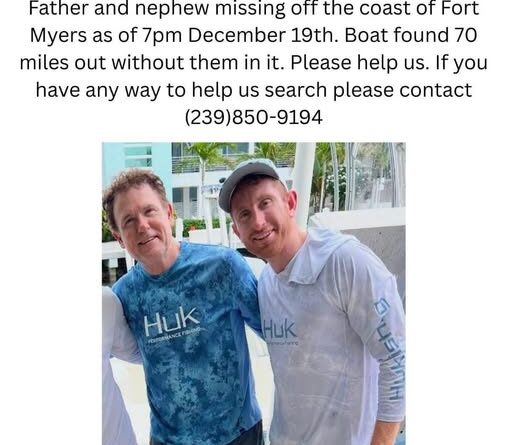
Florida Fisherman Missing
The U.S. Coast Guard announced Friday that it is continuing to search the eastern Pacific Ocean for individuals who jumped from suspected drug‑smuggling vessels after the U.S. military carried out strikes on the boats several days earlier. Officials acknowledged that the chances of finding survivors have grown increasingly slim.
Search operations began Tuesday afternoon after the military alerted the Coast Guard that people were in the water roughly 400 miles southwest of the Mexico–Guatemala border. A Coast Guard aircraft was deployed from Sacramento to scan an area spanning more than 1,000 miles, and nearby ships were warned to remain alert. According to the agency, more than 65 hours of coordinated search efforts have been conducted, involving international partners as well as civilian vessels.
Conditions in the region have been severe, with 9‑foot waves and 40‑knot winds. U.S. officials have not disclosed how many individuals entered the water, nor how high the death toll may rise as a result of the Trump administration’s months‑long campaign targeting small boats accused of transporting narcotics.
Earlier in the week, the U.S. military reported striking three vessels traveling along established trafficking routes, claiming the boats had transferred narcotics among themselves before the attacks — a statement for which no evidence was publicly provided. U.S. Southern Command said three people were killed when the first vessel was hit, while those aboard the other two boats jumped into the water before the strikes occurred.
The attacks took place in a section of the eastern Pacific where the Navy has no ships deployed. Southern Command said it immediately notified the Coast Guard to initiate search‑and‑rescue operations for those who had abandoned the vessels.
The Coast Guard’s involvement is notable given the scrutiny the military faced after a September incident in which U.S. forces killed survivors of an earlier strike by firing on their disabled boat. Some Democratic lawmakers and legal experts argued that the action constituted a crime, while the Trump administration and several Republican lawmakers defended the legality of the follow‑up strike.
There have been other survivors of recent boat strikes. In late October, the Mexican Navy suspended a four‑day search for one survivor. Two others rescued after a strike on a submersible vessel in the Caribbean were repatriated to Ecuador and Colombia; Ecuadorian authorities later released their citizen, citing a lack of evidence of criminal activity.
Since early September, under the direction of President Donald Trump, the U.S. military has conducted strikes on vessels in both the Caribbean Sea and the eastern Pacific. As of Friday, the administration reported 35 boat strikes and at least 115 deaths.
Trump has defended the campaign as a necessary escalation to curb drug trafficking into the United States, asserting that the country is engaged in an “armed conflict” with drug cartels. The strikes have coincided with an expanded U.S. military presence in the region, part of a broader pressure strategy targeting Venezuelan President Nicolás Maduro, who faces narco‑terrorism charges in the United States.